

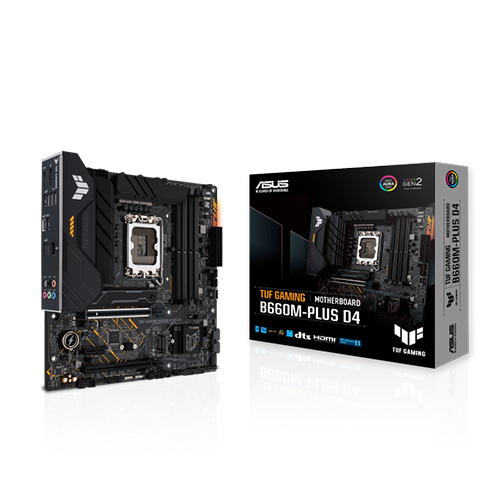


ASUS TUF GAMING B660M-PLUS D4 Intel 12th Gen Motherboard
20,700.00৳
Key Features
- Comprehensive Cooling
- Latest Connectivity
- Made For Online Gaming
- Two-Way AI Noise-Cancelation
ASUS TUF GAMING B660M-PLUS D4 Intel 12th Gen Motherboard
ASUS TUF GAMING B660M-PLUS D4 Motherboard Supports with 12th Gen Intel processors and Intel LGA 1700 socket and Intel Turbo Boost Technology 2.0 and Intel Turbo Boost Max Technology 3.0. This motherboard comes with Enhanced power solution, so that 10 power stages, six-layer PCB, ProCool socket, military-grade TUF components and Digi+ VRM for maximum durability. It has Comprehensive cooling system- Enlarged VRM heatsink, Flexible M.2 heatsink, PCH heatsink, hybrid fan headers and Fan Xpert 2+. Here, PCIe 4.0 slot, PCIe 4.0 M.2 slots, front USB 3.2 Gen 2 Type-C Latest connectivity are also availble. This 12th Gen motherboard specially made for online gaming: Realtek 2.5Gb Ethernet, TUF LANGuard. In this motherboard, it also has Two-way AI Noise-Cancelation, which helps to reduce Reduces background noise from the microphone and audio output for crystal-clear communication in games or video conferences. Multiple PCB layers optimize heat management for critical components, providing more headroom to push CPUs beyond stock speeds. The motherboard comes with upgraded power delivery and comprehensive cooling options to drive the 12th Gen Intel Core processors, plus support for faster memory and storage, TUF GAMING B660 motherboards are the perfect foundation for your next high-core-count battle rig. The TUF GAMING platform gives you the arsenal you need to build and optimize your dream gaming rig, without unnecessary complexity. the new TUF GAMING B660 motherboards provide a high-performance gaming package with a long list of features with including ultrafast networking for smoother online gameplay, pristine audio with positional cues for FPS gaming, and onboard RGB lighting that syncs with attached accessories to help you create a personalized gaming atmosphere. the latest ASUS TUF Gaming B660M-E D4 motherboard.
ASUS TUF GAMING B660M-PLUS Review
One of the great things to come out of Computex was news of cheaper LGA 1700 motherboards via Intel’s soon-to-be-released B660 chipset. The fact that the PCH itself would be a few dollars cheaper was only the start of savings, as halving the number of pathways to the CPU would also reduce motherboard complexity and cost. Designers would also get half as many PCIe 4.0 and half as many PCIe 3.0 lanes controlled by the chipset, so that critics like us wouldn’t scold them for not taking advantage of free resources in a low-cost segment where PCB economization would have dictated this anyway. Heck, even the SATA and USB3 port count—which costs more to implement than simple PCB real estate—was cut in half. None of these cost-saving economizations are likely to repel most non-overclocking performance seekers: The consumer performance market often breaks into separate gaming and home workstation segments, where the later are more likely concerned by the chipset’s inability to split its CPU-based PCIe 4.0 x16 slot into four x4 pathways. That exclusion rules out the using certain multi-drive M.2 storage adapters on the upper x16 slot, including Asus’s own Hyper M.2 x16 Gen 4 Card. Gamers will put a graphics card there.
ASUS B660 SERIES MOTHERBOARD LIST IN BANGLADESH 2022
Be the first to review “ASUS TUF GAMING B660M-PLUS D4 Intel 12th Gen Motherboard”
Related products
Components

Components
Components
Reviews
There are no reviews yet.