

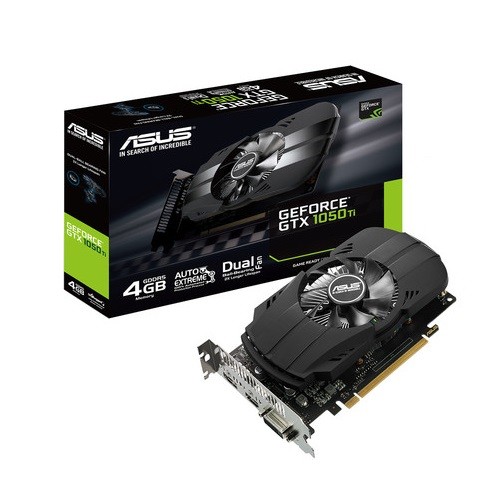
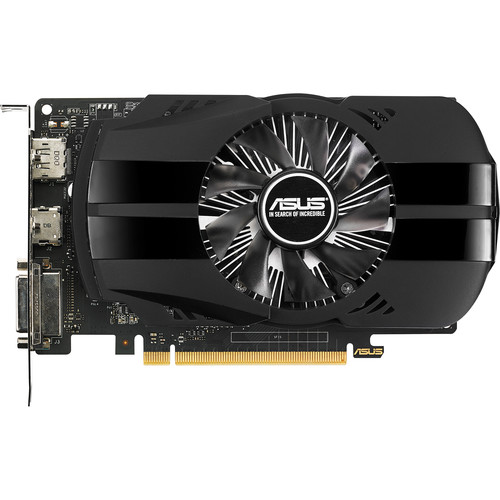
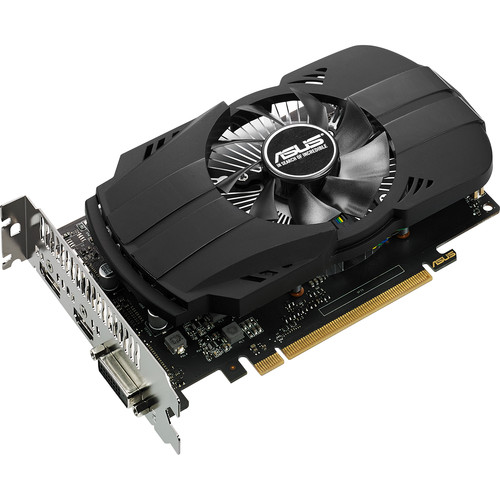
Asus Phoenix GeForce GTX 1050 Ti 4GB GDDR5 Graphics Card
Original price was: 30,500.00৳ .22,500.00৳ Current price is: 22,500.00৳ .
Key Features
- MPN: PH-GTX1050TI-4G
- Industry Only Auto-Extreme Technology with Super Alloy Power II
- NVIDIA ANSEL
- Dual-ball Bearing Fan
- Easy plug and play gaming
Asus Phoenix GeForce GTX 1050 Ti 4GB GDDR5 Graphics Card
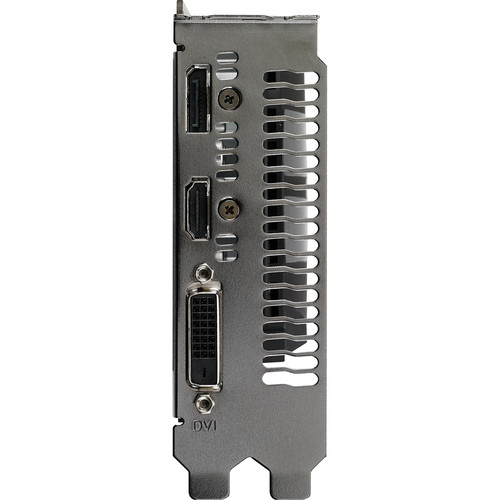
Asus GTX 1050 Ti Graphics Card Provides Major Improvements In Performance, Memory Bandwidth, And Power Efficiency Over Its Predecessor, The Maxwell Architecture. The Front Panel Of The Card Features A Variety Of Outputs Including DisplayPort 1.4 Output, One HDMI 2.0b Output, And One DVI-D Dual-Link Output.
Asus GTX 1050 TiGraphics Card Is Not Just About High-Resolution Gaming; Computationally Intensive Programs Can Utilize The GPU’s 768 Cores To Accelerate Tasks Using CUDA Or Other APIs.This Asus GTX 1050 Ti Graphics Card Features One Dual Ball-Bearing Fan. With Reduced Friction, It Also Runs Smoother, Further Improving Card Lifespan And Cooling Efficiency.ASUS Phoenix GeForce® GTX 1050 Ti Comes Equipped With A Dual Ball-Bearing Fan For A 2X Longer Card Lifespan And Exclusive Auto-Extreme Technology With Super Alloy Power II Components For Superior Stability. Asus GTX 1050 Ti Also Has GPU Tweak II With XSplit Gamecaster That Provides Intuitive Performance Tweaking And Real-Time Streaming. It Provides Best Experience In Games Such As Overwatch, Dota 2, CS Go And League Of Legend.
With Ansel, Gamers Can Compose The Gameplay Shots They Want, Pointing The Camera In Any Direction And From Any Vantage Point Within A Gaming World. They Can Capture Screenshots At Up To 32 Times The Screen Resolution, And Then Zoom In Where They Choose Without Losing Fidelity. With Photo-Filters, They Can Add Effects In Real-Time Before Taking The Shot. And They Can Capture 360-Degree Stereo Photospheres For Viewing In A VR Headset Or Google Cardboard.
The Best For Your Compact Build
Asus GTX 1050 Ti Comes Equipped With A Dual Ball-Bearing Fan For A 2X Longer Card Lifespan And Exclusive Auto-Extreme Technology With Super Alloy Power II Components For Superior Stability. ASUS Phoenix GeForce® GTX 1050 Ti Also Has GPU Tweak II With XSplit Gamecaster That Provides Intuitive Performance Tweaking And Real-Time Streaming. It Provides Best Experience In Games Such As Overwatch, Dota 2, CS Go And League Of Legend.
With CUDA, NVIDIA Allows Applications To Hand Off CPU-Intensive Tasks To The GPU. Your GPU Is No Longer Just Used For Rendering Graphics, But It Can Provide Teraflops Of Floating Point Performance And Accelerate Application Tasks, From Real-Time Video Rendering To Fluid Dynamics Simulation. CUDA Is Used In Many Applications And Games.
2X Longer Lifespan
Without The Problem Of Oil Drying Common In Sleeve-Bearing Fans, Asus GTX 1050 Ti Dual-Ball Bearing Fan On ASUS Phoenix GeForce® GTX 1050 Ti Lasts 2X Longer. With Reduced Friction, It Also Runs Smoother, Further Improving Card Lifespan And Cooling Efficiency
When Used With A Monitor That Has G-SYNC Hardware Installed, Asus GTX 1050 Ti Monitor’s Refresh Rate Will Sync And Lock With The Graphics Card’s Output Frame Rate. Establishing This Sync Removes Tearing And Stuttering Which Can Result From Conventional Fixed Screen Refresh Rates, Especially Important For Gaming In Stereoscopic 3D. An Additional Benefit Of G-SYNC Is Reduced Lag So Gamers Will Benefit From The Improved Command Response Time As Well
Boosts The Card’s Clock Speed In Real-Time Based On The Target Temperature. If Asus GTX 1050 Ti Card Is Running Below The Set Target Temperature, GPU Boost 3.0 Will Increase The Clock Speed To Improve Performance. The Target Temperature Can Be Reset Depending On Your Preference So You Can Have The Card Run More Quietly For Everyday Tasks And Older Games, And Run At Full Tilt During Intense High-Resolution Gaming Sequences.
Asus Phoenix GeForce GTX 1050 Ti 4GB GDDR5 Review
Is it good for gaming? Its plug and play design requires no PCIe power connectors for easy graphics upgrade. You can play Classic and modern games at 1080p @ 60 fps. Gpu tweak II makes monitoring performance and streaming easier than ever. Get more in ASUS GeForce GTX 1050 Ti 4GB Phoenix fan edition DVI-D HDMI DP 1.4 gaming graphics card review.
The Asus GTX 1050 Ti 4GB has a dual ball bearing fan for maximum life expectancy in addition to smooth, quiet cooling. Fan lasts up to 2x longer than traditional fans.
Memory is still 4GB with output display options still rocking one of each: DVI-D, HDMI 2.0b and DisplayPort 1.4. The ASUS PHOENIX GTX 1050 Ti also doesn’t require a PCIe power connector and is completely powered off the PCIe slot.
Frame rates and frame times of a 60-second game play were recorded using FRAPS v3.5.99. The test results are the average of 3 benchmark runs. Since this is a GPU review, we benchmarked the area of the games that put heavy load on the GPU.
The Asus GTX 1050 Ti has a base clock of 1290Mhz and can boost up to 1392Mhz as NVIDIA specs. Memory clock runs at 3504Mhz. The GTX 1050 runs with a base clock of 1354 MHz and has a Boost Clock of 1455 MHz. Memory Clock is also 3504 MHz.
While this is a good technology solution graphics card manufacturers need to find a solution so they can deliver value. Crypto currencies will be the death of graphics cards. Crypto currencies will soon collapse as a result of Quantum computing but not before killing off graphic card manufacturers along the way. Do these manufacturers not understand that there will be a solution to solve the massive overpricing of graphics cards due to crypto mining? LRH is an attempt to solve the problem but is ineffective. No one is going to mourn the loss of graphicss card companies when they finally die and there are technology solutions to this massive overpricing.
If you want to push high frame rates at 1440p and even want to dabble a bit at 4K, the RX 6700 XT will do a great job.
The AMD Radeon RX 6700 XT slots in somewhere between the NVIDIA RTX 3060 Ti and NVIDIA RTX 3070 in terms of raw performance. It also costs about $80 more than the list price of the 3060 Ti, so you have to be sure you’re looking for better power and not a better feature set.
While the RX 6700 XT offers ray tracing, its support isn’t as good as NVIDIA’s, and you will likely see a harder hit to performance. This is true even though AMD’s cards now have FSR, an alternative to DLSS.
Bottom line? The 12GB of VRAM sets the RX 6700 XT up nicely for the future, and FidelityFX Super Resolution is beginning to cut into NVIDIA’s DLSS technology. If you can find an RX 6700 XT close to retail price, it should make a great card for QHD gaming.
Specifications
| Video Memory Specifications | ||
| Type | GDDR5 | |
| Size | 4GB | |
| Resolution | Digital Max Resolution:7680×4320 | |
| Core Clock | GPU Boost Clock : 1392 MHz GPU Base Clock : 1290 MHz |
|
| Memory Clock | 7008 MHz | |
| BUS Type | PCI Express 3.0 | |
| Memory Interface | 128-bit | |
| CUDA Cores | 768 | |
| Interface | ||
| Display Port | Yes x 1 (DisplayPort 1.4) | |
| HDMI | Yes x 1 (Native) (HDMI 2.0b) | |
| DVI | Yes x 1 (Native) (DVI-D) | |
| HDCP | Yes (2.2) | |
| Power Specifications | ||
| Recommended PSU | 300W | |
| Display Option | ||
| Multi Display | 3 | |
| Application Programming Interfaces | ||
| OpenGL | 4.5 | |
| Physical Specifications | ||
| Dimensions | 19.2 x 11.1 x3.7 Centimeter | |
| Warranty | ||
| Manufacturing Warranty | 2 Years | |
Be the first to review “Asus Phoenix GeForce GTX 1050 Ti 4GB GDDR5 Graphics Card”
Related products
Components

Components
Components
Components
Components
Reviews
There are no reviews yet.