



ZOTAC GAMING GeForce RTX 3080 Ti AMP Extreme Holo 12GB GDDR6X Graphics Card
147,000.00৳
Key Features
- MPN: ZT-A30810B-10P
- 2nd Gen Ray Tracing Cores & 3rd Gen Tensor Cores
- SPECTRA 2.0 RGB Lighting
- IceStorm 2.0 Advanced Cooling
- HoloBlack Design
ZOTAC GAMING GeForce RTX 3080 Ti AMP Extreme Holo 12GB GDDR6X Graphics Card
The ZOTAC RTX 3080 Ti AMP Extreme Holo 12GB GDDR6X Graphics Card comes with the NVIDIA Ampere architecture. This Graphics Card is featured with CUDA cores 10240, Video Memory 12GB GDDR6X, 320-bit Memory Bus, Engine ClockBoost: 1710 MHz, Memory Clock19 Gbps, PCI Express4.0 16x. This Graphics card is built with enhanced RT Cores and Tensor Cores, new streaming multiprocessors, and superfast GDDR6X memory. The ZOTAC RTX 3080 Ti AMP Extreme Holo Extreme 12GB GDDR6X Graphics Card is featured with 2nd Gen Ray Tracing Cores, 3rd Gen Tensor Cores, HoloBlack Design, SPECTRA 2.0 RGB Lighting, IceStorm 2.0 Advanced Cooling, Active Fan Control with FREEZE Fan Stop, and Metal Frontplate and RGB LED Backplate. It gives rise to amplified gaming with ultra graphics fidelity in style. It supports in Windows 10 64-bit (build 2004 or later) operating system.
ZOTAC GAMING GeForce RTX 3080 Ti AMP Extreme Holo 12GB GDDR6X Review
Considering the jump in price, you might think you’ll be getting a lot of extras, plus higher performance, but that’s not really the case here. Yes, the ZOTAC RTX 3080 Ti AMP Extreme Holo (or HoloBlack) sports plenty of RGB bling, if that’s to your liking. The cooler also generally does better than the reference model Founders Edition, with lower GDDR6X temperatures in our testing. The boost clock meanwhile is 1710MHz, a mere 45MHz higher than the reference clocks. Generally speaking, that means any differences in performance between the reference card and the Zotac Holo are due to margin of error in the benchmarks rather than any significant difference between the cards.
Note that the boost clocks are quite conservative, and we measured significantly higher GPU clocks than what Nvidia advertises in most games. That’s typical of Nvidia’s approach to reporting boost clocks: under promise and over deliver. In our Metro Exodus testing as an example, the 3080 Ti Founders Edition averaged 1840MHz, while the Zotac averaged 1833MHz—yes, the card with the theoretically 45MHz higher boost clock actually ran 7MHz slower. It’s mostly just noise and variation between benchmark runs, but we don’t recommend anyone buy the 3080 Ti Holo with the expectation that it will significantly outperform other 3080 Ti cards.
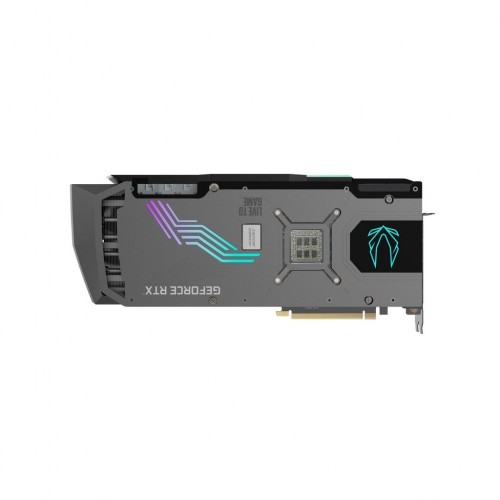
The ZOTAC RTX 3080 Ti AMP Extreme Holo uses the same board design and cooler as the existing RTX 3090 Amp Holo and RTX 3080 Amp Holo, though we never actually reviewed either of those. It’s a triple-slot card, and the “holo” part of the name apparently refers to the iridescent coating on the strip around the RGB Zotac Gaming logo. The card uses programmable lighting, so you can have it blink, cycle through the colors of the rainbow, or a few other effects. There’s additional RGB lighting on the back of the card, with some lines and a Zotac logo.
The ZOTAC RTX 3080 Ti AMP Extreme Holo tips the scales at just over 1.5kg, making it a rather chunky card. It’s also a pretty long card, at around 12.5 inches (317mm according to Zotac), and it’s 5.2 inches (131.8mm) tall. Needless to say, it’s not the sort of card you’d want to try to cram into a compact case. Most of the bulk comes from the massive heatsink, which completely dwarfs the more modestly sized PCB.
All of the memory chips make contact with the heatsink as well, via 2mm or thicker thermal pads. This is all good news for anyone concerned with GDDR6X temperatures. The three fans also help with cooling, and each one measures about 90mm in diameter, though these lack the integrated rim that many newer cards opt for, since it helps increase static pressure and thus cooling performance.
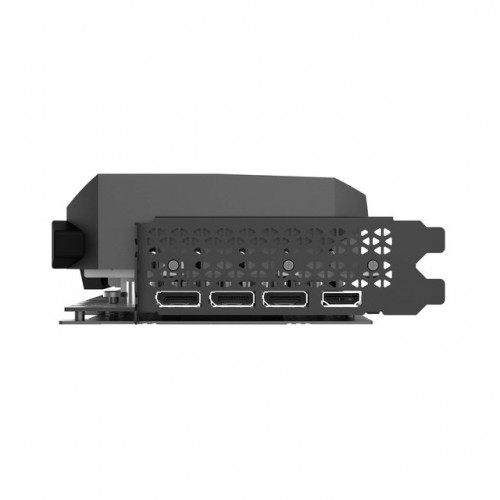
Other than the cooler and lighting, the remaining specs are pretty tame for such an expensive graphics card. Video output consists of a single HDMI 2.1 port, along with three DisplayPort 1.4 pots. The card has two 8-pin PEG power connectors, and the TDP maintains the same 350W value as the reference 3080 Ti (though in testing, the Zotac card actually used a bit less power than the Founders Edition).
Our test configuration for the hardware and software remains unchanged from other recent reviews. We’re using an 8-core/16-thread Core i9-9900K running stock clocks, but with DDR4-3600 memory and the XMP profile enabled. The CPU generally runs at 4.7GHz during our gaming benchmarks, though the slightly older Coffee Lake architecture can be a bit of a bottleneck at lower resolutions.
Since we’ve already tested ray tracing and DLSS performance using the reference Founders Edition, for the third-party cards we’re only going to look at our standard 13 game test suite, running at 4K, 1440p, and 1080p and ultra settings. Each test setting gets run multiple times, to ensure the consistency of our results. Considering the relatively similar specs on the Zotac 3080 Ti and the 3080 Ti FE, we should see very little difference between the two cards.
Specifications
| Video Memory Specifications | ||
| Type | GDDR6X | |
| Size | 12GB | |
| Resolution | 7680×4320 | |
| Core Clock | Boost: 1785 MHz | |
| Memory Clock | 19.0 Gbps | |
| BUS Type | 384-bit | |
| Memory Interface | PCI Express 4.0 16x | |
| CUDA Cores | 10240 | |
| Others | IceStorm 2.0 | |
| Interface | ||
| Display Port | 3 x DisplayPort 1.4a (up to 7680×4320@60Hz) | |
| HDMI | HDMI 2.1 (up to 7680×4320@60Hz) | |
| HDCP | 2.3 | |
| Power Specifications | ||
| Connectors | 3 x 8-pin | |
| Recommended PSU | 800W | |
| Consumption | 400W | |
| Display Option | ||
| Multi Display | Quad Display | |
| Application Programming Interfaces | ||
| DirectX | 12 Ultimate | |
| OpenGL | 4.6 | |
| Physical Specifications | ||
| Dimensions | 355.9mm x 145.7mm x 59.7mm / 14″ x 5.7″ x 2.4″ | |
| Others | 3 slot | |
| Warranty | ||
| Manufacturing Warranty | 02 years warranty (3 Years Warranty available if registered online within 28 days of Purchase) Total warranty:- 2+ 3 ( after reg.) = Total 5 years | |
Be the first to review “ZOTAC GAMING GeForce RTX 3080 Ti AMP Extreme Holo 12GB GDDR6X Graphics Card”
Related products
Components
Components
Components
Components

Components
Components
Reviews
There are no reviews yet.