



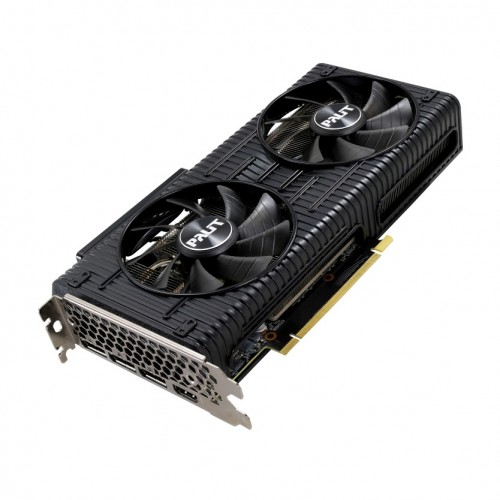
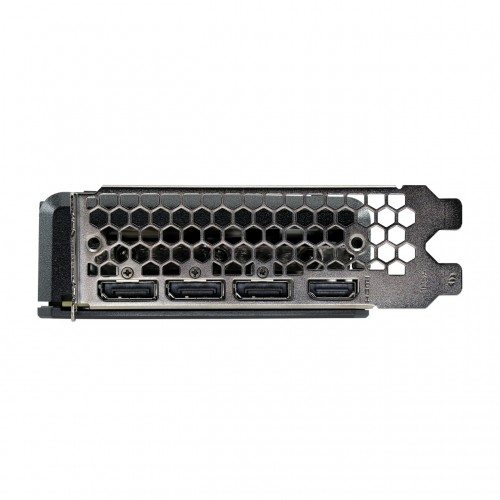
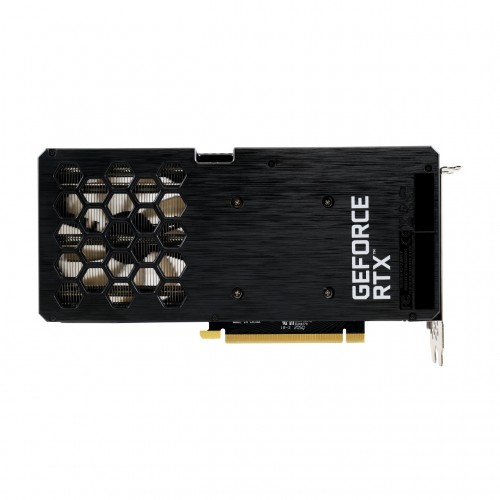
Palit GeForce RTX 3060 Dual 12GB GDDR6 Graphics Card
Key Features
• Memory Interface: 192bit
• Graphics Clock: 1320 MHz, Boost Clock: 1777 MHz
• Memory Clock: 15 Gbps
• CUDA Cores: 3584
Palit GeForce RTX 3060 Dual 12GB GDDR6 Graphics Card
Palit GeForce RTX 3060 Lets You Take On The Latest Games Using The Power Of Ampere—NVIDIA’s 2nd Generation RTX Architecture. Get Incredible Performance With Enhanced Ray Tracing Cores And Tensor Cores, New Streaming Multiprocessors, And High-Speed G6 Memory.
Palit GeForce RTX 3060 Dual Series Features Two 90mm Big Fans For Efficient Cooling Performance, And Large Cut-Through Area On The Back Plate For Optimized Heat Ventilation. Customizable RGB Lighting Is Also Decorated On The Side Of The Shroud For Gamers To Enjoy Minimalist Lighting Effects.
RGB Lighting
Palit GeForce RTX 3060 Color Lighting From RGB LED Can Be Changed In Accordance With Graphics Temperature. Palit GeForce RTX 3060 Temperature Can Easily Be Identified By Different Colors From The External Appearance Of The Graphics Card. Gamers Can Choose From 16.8 Million Colors To Suit Their Own Style And Preferences.
0-DB TECH
Keep Silent While You Are Experiencing The Multimedia Application And General Workload. The Operating Fans Only Occurs While Working On Heavier Loading.
DrMOS
DrMOS, Originally Only Available For High-End Server CPUs, Is Now Available In All Its Glory In The Next Generation Of Palit Graphics Cards. DrMOS Offers High Current Circuits, Low Noise Operation, And Effective Reduction Of Heat Generating.
ThunderMaster
Palit’s New Thunder Master Has Thorough Upgrade From The Previous Version. It Has More User-Friendly Interface As Well As More Personalized Settings. With ThunderMaster, You Can Control Your Video Card From Overclock Setting, Fan Speed To LED Effect. You Can Also Monitor GPU Status With ThunderMaster Utility.
Honeycomb Bracket
Palit GeForce RTX 3060 Design Of Honeycomb Bracket Increases Airflow By Up To 15%, Allowing The Heat Generated From GPU To Be Exhausted Via The Honeycomb Design Bracket. This Enables More Efficient Cooling Effects.
Stream Like A Boss
Steal The Show With Incredible Graphics And Smooth, Stutter-Free Live Streaming. Next-Generation Hardware Encoding And Decoding Combine To Show Off All Your Best Moments In Exquisite Detail. And The All-New NVIDIA Broadcast App Takes Your Livestreams To The Next Level With Powerful AI Capabilities To Improve Audio And Video Quality With Effects Like Virtual Background, Webcam Auto Frame, And Microphone Noise Removal. GeForce RTX™ 30 Series GPUs Deliver The Performance And Image Quality Necessary To Give Your Audience Your Best Every Time.
Stream Like A Boss
Steal The Show With Incredible Graphics And Smooth, Stutter-Free Live Streaming. Next-Generation Hardware Encoding And Decoding Combine To Show Off All Your Best Moments In Exquisite Detail. And The All-New NVIDIA Broadcast App Takes Your Livestreams To The Next Level With Powerful AI Capabilities To Improve Audio And Video Quality With Effects Like Virtual Background, Webcam Auto Frame, And Microphone Noise Removal. GeForce RTX™ 30 Series GPUs Deliver The Performance And Image Quality Necessary To Give Your Audience Your Best—Every Time.
Victory Measured In Milliseconds
NVIDIA Reflex Delivers The Ultimate Competitive Advantage. The Lowest Latency. The Best Responsiveness. Powered By GeForce RTX™ 30 Series GPUs And NVIDIA® G-SYNC® Gaming Monitors. Acquire Targets Faster, React Quicker, And Increase Aim Precision Through A Revolutionary Suite Of Technologies To Measure And Optimise System Latency For Competitive Games.
DLSS AI ACCELERATION
MAX FPS. MAX QUALITY. POWERED BY AI.NVIDIA DLSS (Deep Learning Super Sampling) Is Groundbreaking AI Rendering Technology That Increases Graphics Performance Using Dedicated Tensor Core AI Processors On GeForce RTX™ GPUs. DLSS Taps Into The Power Of A Deep Learning Neural Network To Boost Frame Rates And Generate Beautiful, Sharp Images For Your Games.
Palit GeForce RTX 3060 Dual 12GB GDDR6 Review
We travel to the premises of PALIT, which released their DUAL OC GeForce RTX 3060, also with 12GB, 3584 shading processors activated and with a default boost clock of 1837 MHz the OC edition graphics card has been tweaked straight out of the box for you.
With that 3584 shading cores and Ampere architecture, this 3060 series is bound to impress in the 2560×1440 (WQHD) domain. If we look back at the previous generation, the product would sit at GeForce RTX 2070 (SUPER) performance levels and, in due time, will replace that series. If stock becomes available in plentiful volumes though. The GPU is again fabricated on an 8nm node derived from Samsung. This process further develops Samsung’s 10nm process; no EUV is applied in production just yet. The first wave of announcements has seen the GeForce RTX 3080 and 3090 being released first, and, as a bit of a surprise, the GeForce RTX 3060 Ti and 3070. It’s now late February 2021 and NVIDIA is set to release its more ‘regular’ 3060 prices 329 USD.
As you will have noticed, the 3060 GPU cores count is about 26 percent lower than with the RTX 3060 Ti, which has a GA104 chip with 4864 shading cores (shader/stream/cuda cores = all the same thing with a different name). NVIDIA is launching the 3060 series with the 12GB model, which’s remarkably enough is 2GB more than the GeForce RTX 3080 (!). Later on, they’ll likely silently slip in a 6 GB version, though that has not been confirmed. NVIDIA advertises the series with 13 ‘shader teraflops’ and 25 ‘RT-ops’, the latter giving an indication of the ray-tracing performance. Notable is that a change is in effect, the memory runs ar 15 Gbps as opposed to the usual 14 Gbps, likely to compensate for the perf hit of going 256-bit towards 192-bit on the memory bus due to that memory configuration. It’s the same for the shader core cluster, it’s clocked higher in the boost frequency compared to the Ti model, also compensating a bit for the lower number of shader cores.
Palit GeForce RTX 3060 Ampere lineup nearly doubles ray-tracing performance with Gen2 ray-tracing cores and 3rd iteration Tensor cores. These cards will all be PCIe 4.0 interface compatible and offer HDMI 2.1 and DisplayPort 1.4a, but most importantly is that exorbitant shader processor count (referred to as CUDA cores by NVIDIA). With just over a third of the shader processor count seen from the flagship product, we now meet the NVIDIA GA106 GPU. And despite being a lower segmented card, it still holds a sizable GPU die. In this round, NVIDIA is not seeding Founder edition cards, aka FE GeForce RTX 3060. But of course, they do present the reference specification; a boost clock of 1780 MHz and a base clock of 1320 MHz.
Yeah, so if it has that OC in the name, it means it’s tweaked a little! The DUAL OC card comes as a more valuable product that should sit closer towards MSRP pricing. That proper shader core count on the GPU is paired with 12GB GDDR6 graphics memory at 192-bit running at 15 Gbps. It is a simplified-looking product that comes with a mild factory tweak, making it perform slightly above reference/baseline performance. Dual refers towards the cooler with its duo of spinners. The card has a single (6+2) pin power header. Armed with a BIOS that offers an 1837 MHz Turbo (1780 MHz = reference). The card is rated by us at 175 Watt power draw (typical). Anyway, let’s have a look at how well the product performs.
It’s the glimmer of hope that kills you, isn’t it? Each time a new graphics card is launched alongside the promise of improved stock, you get a sense that some folk may actually be able to grab one. The reality is that GeForce RTX 3060, introduced last week, mirrored every other major GPU launch from the past six months. Retailer listings went live, prices quickly escalated to way above the RRP, and then suddenly there’s no stock available anywhere other than Ebay. Rinse, repeat.
There’s clearly plenty of frustration out there – it has been fascinating to hear about our readers’ own experiences – and there doesn’t appear to any imminent solution.
There’s also good news for AIB partners in there’s no Nvidia Founders Edition occupying the limelight, and all the big names have stepped up with a wide range of custom designs. Palit’s arsenal has four models, including the intriguing StormX – a single-slot, ultra-compact design for small-form-factor PCs – and the more familiar Dual. Each is available in regular and OC variants, and it’s the Dual OC that has spent the past few days inside our trusty Ryzen 9 test platform.
Look familiar? That’s because Palit has borrowed the same cooler as the RTX 3060 Ti model, albeit with a subtle tweak to RGB lighting. This time around, only the GeForce RTX branding across the top edge is illuminated, which is a shame as the LEDs surrounding the honeycomb pattern on the Ti variant work quite well.
Lighting aside, board dimensions are practically identical at 245mm x 119mm x 40mm and though the plastic shroud feels lightweight in parts, it’s nice to see a backplate included as standard. Palit’s all-black design is likely to suit most builds, and a dual-fan cooler of this size will have no trouble taming the small underlying 276mm² GA106 GPU.
Both 90mm fans switch off at low load, with reasonably smooth transitions between on/off states, and given that the PCB ends just after the eight-pin PCIe power connector, it’s safe to say the magnitude of the cooler is overkill for a card of this ilk. Still, that full-length aluminium heatsink isn’t going to do any harm, but it’s a shame Palit didn’t do more to hide the internal fan header and cables. Clearly visible through the cutout in the shroud, they detract from the overall finish when the card is mounted horizontally.
An ‘OC’ designation reveals an out-the-box enhancement, and it is no surprise to find the Palit card shipped with the exact same frequencies as the recently reviewed Gigabyte Gaming OC. Boost clock climbs from 1,777MHz to 1,837MHz, while the surprisingly large 12GB frame buffer remains glued to 15Gbps. Healthy numbers, though what’s written on the box doesn’t always translate to what you see in the real world. In our labs the Gigabyte card managed an average in-game frequency of 1,995MHz during testing, while the Palit settled in at around 1,930MHz.
Display outputs comprise the familiar quartet of three DisplayPort 1.4 and a single HDMI 2.1, and from an implementation perspective there’s not a great deal more Palit could do.
Specification
| Video Memory Specifications | ||
| Type | GDDR6 | |
| Size | 12G | |
| Resolution | 7680×4320 | |
| Core Clock | Graphics Clock: 1320 MHz Boost Clock: 1777 MHz |
|
| Memory Clock | 15 Gbps | |
| BUS Type | PCI-E 4.0 | |
| Memory Interface | 192bit | |
| Stream Processors | NVIDIA GameStream Technology | |
| CUDA Cores | 3584 | |
| Interface | ||
| Display Port | DP1.4a x 3 | |
| HDMI | HDMI 2.1 | |
| Power Specifications | ||
| Connectors | 8-pin x 1 | |
| Recommended PSU | 550 W | |
| Consumption | 170 W | |
| Display Option | ||
| Multi Display | 4 | |
| Application Programming Interfaces | ||
| DirectX | Microsoft DirectX 12 Ultimate | |
| OpenGL | 4.6 | |
| Physical Specifications | ||
| Dimensions | 245x119x40mm | |
| Others | 2 Slot | |
| Warranty | ||
| Manufacturing Warranty | 2 years | |
Be the first to review “Palit GeForce RTX 3060 Dual 12GB GDDR6 Graphics Card”
Related products

Components

Components

Components
Components
Components
Components
Components
Reviews
There are no reviews yet.