



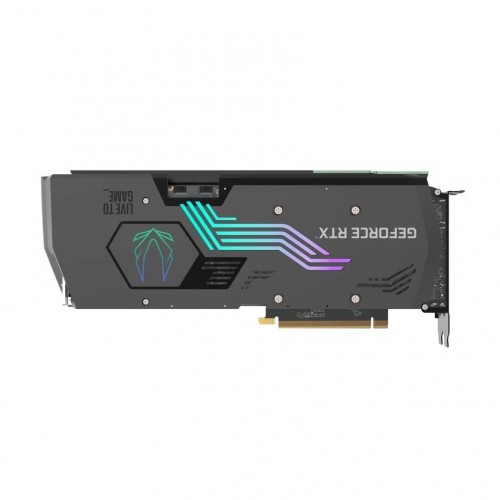
ZOTAC GAMING GeForce RTX 3080 AMP Holo LHR 10GB Graphics Card
Key Features
- MPN: ZT-A30800F-10PLHR
- 2nd Gen Ray Tracing Cores & 3rd Gen Tensor Cores
- HoloBlack Design, Active Fan Control
- SPECTRA 2.0 RGB Lighting
- LHR 43 MH/s ETH hash rate (est.)
ZOTAC GAMING GeForce RTX 3080 AMP Holo LHR 10GB Graphics Card
The ZOTAC RTX 3080 AMP Holo LHR AMP Holo LHR 10GB Graphics Card comes with the NVIDIA Ampere architecture. This ZOTAC GAMING GeForce RTX 3080 is featured with CUDA cores 8704, Video Memory 10GB GDDR6X, Memory Bus 320-bit, Engine Clock Boost: 1770 MHz, Memory Clock19 Gbps, PCI Express4.0 16x. This Graphics card is built with enhanced RT Cores and Tensor Cores, new streaming multiprocessors, and superfast GDDR6X memory. The ZOTAC RTX 3080 AMP Holo LHR 10GB Graphics Card featured with 2nd Gen Ray Tracing Cores, 3rd Gen Tensor Cores, HoloBlack Design, SPECTRA 2.0 RGB Lighting, IceStorm 2.0 Advanced Cooling, Active Fan Control with FREEZE Fan Stop and Metal Frontplate, and RGB LED Backplate. The ZOTAC RTX 3080 AMP Holo LHR gives rise to amplified gaming with ultra graphics fidelity in style. It supports in Windows 10 64-bit (build 2004 or later) operating system.
ZOTAC GAMING GeForce RTX 3080 AMP Holo LHR 10GB Review
ZOTAC RTX 3080 AMP Holo LHR AMP Holo should be immediately familiar to anyone who has seen the product line before. Much DNA has been shared with Zotac’s standardized approach to triple fan graphics cards, especially since Turing, with many of the company’s GPUs sharing the same aesthetics. The key difference here, however, is the ‘HoloBlack’ design, as both the base of the GPU and the side of it are adorned in bright RGB lighting.
It may not look like much before you switch things on, but once it’s slotted in, the Zotac Gaming GeForce RTX 3080 AMP Holo really breathes new life into a rig, especially one like mine which is already full to bursting with bright colors from all major components.
Lights aside, this graphics card is incredibly well built, with a metal front and backplate that helps to protect the vital elements inside it well. What’s more, unlike what you’ll see on the Founder’s Edition model, the Zotac Gaming GeForce RTX 3080 AMP Holo requires the standard 2 x 8-pin power instead of a 12-pin adapter, and fortunately cables are included in the box, should your PSU not have the right leads.
Aesthetics aside, the Zotac Gaming GeForce RTX 3080 AMP Holo benefits from a slightly higher boost clock of 1770 MHz over the Founder’s Edition’s 1710 MHz, meaning you can overclock that little bit further. It may not sound like much now, but should you want to squeeze every bit of juice out of the GPU, then this extra bump will deliver a couple of extra frames which could make all the difference in the future.
It’s very much your standard fare as far as video out options are concerned; you’ll find 3x DisplayPort 1.4 and 1x HDMI 2.1 to accommodate for resolutions and refresh rates of up to 4K 120 or 8K60. As you may expect, it’s compatible with all the best gaming monitors. On the technical front, this GPU is working with 8,704 CUDA cores, 10GB GDDR6X memory, and a 320-bit memory bus clocked at 19 Gbps. That’s some serious bandwidth, and more than enough to keep up with the vast majority of titles, as you’ll see later.
Naturally, you’re also benefiting from the Firestorm Utility software which can give you real-time performance monitoring as well as Active Fan Control to give you greater control over your performance. For reference, we kept everything as it came out the box with our review unit, but having the option to easily dial things up to 11 is certainly appreciated, especially when gaming in 2160p where the extra power counts the most.
The ZOTAC RTX 3080 AMP Holo LHR AMP Holo is an incredibly strong performer at both 1440p and 4K. With this particular GPU line being specifically marketed on its ray tracing 2160p prowess, I thought it best to stress test the card in some of the most demanding games on the market to see how well it could live up to this claim. For the most part, you’re looking at well above 60 FPS in 4K at Ultra settings in the latest games. The only exception, as you will see in the benchmarks, is Cyberpunk 2077.
Indeed, there’s very little that the Zotac Gaming GeForce RTX 3080 AMP Holo can’t do in 4K, especially when factoring in DLSS. As a frame of reference, we kept the playing field as level as we could by testing every title with the setting set to ‘Performance’ mode or running natively. You can expect 4K frame rates above 100 FPS when utilizing RTX capabilities (ray tracing and DLSS) in tandem, but things do start to slow down when pushing games to the limit in 2160p natively; something that only the RTX 3090 can do reliably (yet).
The ZOTAC RTX 3080 AMP Holo LHR AMP Holo, expectedly, chewed through the vast majority of games in my library at both 1440p and 2160p, with the most commendable performance coming from Metro Exodus (PC Enhanced Edition). This title features ray tracing on as standard, so when cranked up to Extreme settings (its version of Ultra) the visual fidelity can become seriously staggering.
Armed with DLSS, you can achieve framerates of 87 average with no real hit to the resolution to speak of. If you’re wanting to push the refresh rate higher, though, dropping down to 1440p will see well above 120 FPS average in-game for not just Metro Exodus, but also Control, too.
It’s in the native 2160p performance that the Zotac Gaming GeForce RTX 3080 AMP Holo begins to struggle a little bit, with still playable framerates hovering around the 30 FPS range with all sliders cranked up as far as they will go. If you’re someone that can sacrifice performance for visuals then this is unlikely to be a problem for you here, but I recommend keeping DLSS enabled when in 4K or scaling your resolution down a bit where possible.
Guardians of the Galaxy, being one of the more visually striking and well-optimized PC games to release recently, was no problem at all for this RTX 3080 GPU. I averaged 91 FPS with everything set to the maximum with DLSS and ray tracing enabled. Native performance was also solid, too. Switching DLSS off completely in 4K still yielded a decent average of 46 FPS, though 1440p doubles that to 84 for a silkier gameplay experience.
Specification
| Video Memory Specifications | ||
| Type | GDDR6X | |
| Size | 10GB | |
| Resolution | Up to 7680×4320@60Hz | |
| Core Clock | Boost: 1770 MHz | |
| Memory Clock | 19 Gbps | |
| BUS Type | 320-bit | |
| Memory Interface | PCI Express 4.0 16x | |
| Stream Processors | New streaming multiprocessors | |
| CUDA Cores | 8704 | |
| Others | Supported OS: Windows 10 64-bit (build 2004 or later) Slot Size: 2.5 slot CoolingIceStorm 2.0 |
|
| Interface | ||
| Display Port | 3 x DisplayPort 1.4a (up to 7680×4320@60Hz) | |
| HDMI | HDMI 2.1 (up to 7680×4320@60Hz) | |
| HDCP | 2.3 | |
| Power Specifications | ||
| Connectors | Power Input 2 x 8-pin | |
| Recommended PSU | 750W | |
| Consumption | 340W Maximum | |
| Display Option | ||
| Multi Display | Quad Display | |
| Application Programming Interfaces | ||
| DirectX | 12 Ultimate | |
| OpenGL | 4.6 | |
| Physical Specifications | ||
| Dimensions | 317.8mm x 131.8mm x 59.6mm / 12.5″ x 5.2″ x 2.3″ | |
| Warranty | ||
| Manufacturing Warranty | 02 years warranty (3 Years Warranty available if registered online within 28 days of Purchase) Total warranty:- 2+ 3 ( after reg.) = Total 5 years | |
Be the first to review “ZOTAC GAMING GeForce RTX 3080 AMP Holo LHR 10GB Graphics Card”
Related products
Components
Components

Components
Reviews
There are no reviews yet.